Every Day Social Media

July 21, 2008

Time Magazine Cover - Social MediaTraditional media’s days as the main source of information are numbered. Giants like newspapers, television and radio are taking a back seat to the onset of social media as the most popular way we interact and discuss the subjects that are important to us. Web 2.0 and the read/write web has made it easy for everyone to share and discuss opinions, find new information and discover those with similar ideas and interests. Without adapting and evolving, old media will find themselves playing catch-up or worse, branded insignificant and out of date. Of course the progressive outlets are embracing this shift in the fundamentals and using it to their advantage. Major newspapers, radio stations and television networks now have significant online presences and encourage the interaction that is driving our daily lives. But they find themselves in competition like never before. As social media grows, more options are available to users every day, forming a whole new basis for every aspect of how we get and share information.

With the advent of social networking and social bookmarking sites, users now have the unique ability to make connections with others they would have never had the opportunity to meet. They can share interests, recommendations, and pretty much anything else online or off. Almost seamlessly, social media has integrated into our everyday lives and continues to reshape our online experience. With that, advertising and marketing campaigns have had to adapt to encompass this popular medium. Take a look at some of these common online activities and see how often you use social media:

  • Ever sent or received an email? That’s the earliest form of social media.
  • Ever read reviews on a product from other consumers? Or written one yourself? That’s one of the most popular social media functions.
  • Have a MySpace, Facebook, LinkedIn or other networking profile? You’re participating in the largest social connection experiment ever.
  • Ever shared a website, story, picture or video you found online with a someone else? That’s social bookmarking in it’s simplest form.
  • Ever read an online newspaper or magazine? Major news, tv stations or opinion sites? Chances are these popular sites are in the form of blogs; frequently updated content in chronological order, with reader interaction.

There’s many more examples of how social media has taken a foothold in our daily lives, but these are some widely adopted instances. As a prime example of how social media can affect everyone and our culture, you only need to look as far as the current presidential race. The presumptive Democratic nominee, Barack Obama, has implemented a massive social media campaign online to mobilize his supporters and garner donations. This incorporated not only building profiles on almost every social networking site online and managing those connections, but also developing an integrated social media community on his website. This allows the candidate to openly communicate back and forth with his constituents, they can interact with each other, create blogs, start fundraising campaigns and more. This approach has yielded staggering results in both raising money for the campaign and connecting with more potential voters and organizers. Chris Hughes, a 24 year old co-founder of Facebook, helped develop this strategy for Obama, and more details of the campaign can be found at this Seattle Times article.

Social media is on its way to being the foundation for all online communication and collaboration. Traditional media has taken notice and is scrambling to keep up. Every day, our lives are connected more and more and we’ll continue to reach out to new people, information and applications. Social media advertising has also become a fundamental aspect to an effective online marketing campaign because of social media’s popularity, and will continue to grow. If we’ve come this far in just a few short years online, imagine where we’ll be after the next few.

Business Blogs and Beyond

June 30, 2008

Business Week Beyond BlogsIn 2005, Business Week premiered one of the defining articles for business owners and their place online. “Blogs Will Change Your Business” was the title, and the article made many waves in the industry as one of the first from mainstream media to truly acknowledge the power and impact of blogging on business. Since then, thousands of articles in thousands of publications have showcased how the evolution of media and the web has made a fundamental impact on how we do business, not just online, but in virtually every corner of our culture.

The original article had a realistic and objective view of how a business could benefit from a blog. From creating an online identity and building credibility, to market testing and customer interaction, business blogs served more purposes than could be covered in one article. Business Week also stressed the importance of clearing away the clutter - although the numbers for this kind of media were staggering, not everything was worth reading. It was vital to have something to say, to entice and captivate readers while at the same time encourage interaction and feedback. Along with this realistic approach, the article highlighted industry mavericks and major corporations who had jumped on the blogging wagon and what kind of response they’d received. Certainly the movement behind this new tool of communication was broad, but where would it go?

Fast-forward three years later, and the landscape has changed significantly. Business blogs are no longer a tool of the cutting edge business owner or marketing department, they are now a prerequisite for success. Social Media takes off in the form of social bookmarking sites like del.icio.us and Digg, social networking giants like MySpace and Facebook command millions in marketing power, and wikis and micro-blogging phenomenons like Twitter re-shape how we communicate in and outside of the workplace. It’s a wild new world, and Business Week looks to update their original article to encompass this new business model. Although a little outdated, the original article ranked very well under popular keywords in search engines, had been linked to many times, and even was part of the core teaching curriculum in college business classes. To ensure they were up to date, business week enlisted the help of the blogging community to help re-write the original article and bring it current. The new article, “How Social Media Will Change Your Business,” is basically a new version of the original article. It succeeds in addressing the new power of Social Media that dominates today’s online culture, and reports some interesting statistics:

  • In 2005, Technorati (a blog search engine) followed 9 million blogs. Today, the number is 112 million and growing.
  • These days, 24.8% of adults read a blog at least once a month.
  • Currently, there are 120,000 new blogs created every day.
  • Of 150 of the world’s top bloggers, the top 10% earn on average $50,000 per month from their blogs.

Business blogs and social media have become the mainstream, and there isn’t the kind of bubble around blogging that could burst. Evidence of the acceptance of blogs go all the way to the top of Corporate America, where people like Bob Lutz, the vice-chairman of General Motors has a blog, appropriately named Fastlane. Where will the next wave of online culture lead us? Web 3.0 is just beginning to gain steam as the new model is once again re-written, but it’s just another level. Business blogs, social media and the changes that go along with these marketing fundamentals will be constants for a long time to come and continue to build the foundation for how we’ll do business in the future.

Social Media in Plain English

May 30, 2008

The folks over at Common Craft have put together a new video that explains social media titled “Social Media in Plain English”. This one features a town that has a serious love of ice cream and the how the residents embrace the fundamentals of social media to everyone’s benefit. You might remember Common Craft from their video explanations of Social Bookmarking and Social Networking. They’ve also covered topics like RSS, Blogs, Podcasting and even Zombies.

The videos themselves are great explanations of complex topics. I’ve heard the “I get it now!” exclamation many times after directing a friend or colleague to one of these videos. Admittedly so, Web 2.0 has introduced a new landscape of terminology and applications that will take a little while for complete adoption by the typical user community, so I think these videos provide a great translation medium. Take a look:

What is Web 2.0?

May 22, 2008

When it comes to internet marketing, Web 2.0 has redefined the rules. Every fundamental aspect of owning an online business now must incorporate this concept to ensure the potential for positive results. The days of building a site and optimizing it for search engine results are over; there’s someone else who already did that and is moving forward with the next step in their campaign. To win the race, we’ve got to outthink our competitor and outperform them online. To accomplish that, we have to understand the newest concepts in marketing and embrace them as our own. Enter Web 2.0, the natural evolvement of the web and the information within it.

That being said, let’s take a step back. What is Web 2.0? What does it mean and how does it affect marketing and e-commerce? Unfortunately, a concise definition of Web 2.0 has yet to be realized, mostly because it’s an idea that’s still being debated. Wikipedia is the most comprehensive source out there, but it leaves something out in terms of what impact it has had and why it’s important to us.  Let’s start by attempting a simple, understandable definition for our purposes.

What is Web 2.0?

Web 2.0 is the concept that the internet has evolved into a platform on which users interact and have the ability to own and edit the data within. It is the change from isolated websites with a one-way flow of information to that of free-flowing, open-ended communication and data exchange. Social media, including blogs, social networks and social bookmarking sites are prime examples of Web 2.0. Basically, Web 2.0 is defined by interaction, usually facilitated through the ability to upload as well as download information. The internet is the tool for doing this, and therefore the concept of Web 2.0 is built on this platform, encouraging user-generated content, communication and categorization.

Although the definition might be missing some concrete themes, the websites that are hallmarks of Web 2.0 tell the real story. Take blogs for example. Although they’ve been around for quite some time, they’ve only become a business mainstay in the last 18 months or so. A blog is a platform for interaction. There can be multiple users, contributors and conversations. A blog can allow any type of media sharing, including photos, music, videos, podcasts, etc. A blog allows two-way conversations to happen and encourages user-driven content. If we compare this to a typical e-commerce site, we can see how Web 2.0 allows the user to participate and therefore become part of the process. After all, we’re going to be the ones providing all this data and categorizing it.

Now that we have an idea of what Web 2.0 is, we need to look at what it means and how it affects us. This is arguably where most of the previous rules of e-commerce have been rewritten. Our audience is using the internet differently these days. The amount of data online about products, services and companies is so vast and easily accessed that consumers are presented with a massive supply of choices and information. Because of that, consumers are becoming savvier, using these Web 2.0 fundamentals to research, discuss and share. It’s digital word of mouth advertising, and there’s no shortage of opinions.

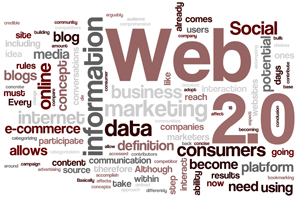
Web 2.0 Chart

So where do we fit in as marketers? If we’re the ones trying to reach these consumers, we must do so on their own ground. We need to go where they are and be perceived as an information source; as a credible, professional company who embraces the technology of the future, not one that hides from it. Web 2.0 allows this is a very profound way. If we contribute to the data, participate in the communities, provide the information, we can reach a highly-coveted group and secure them for a lifetime. It’s truly a marriage between marketers and consumers, and those that are using it effectively are enjoying a lasting relationship.

This all points to the same conclusion: evolve or die. We know our competitors will eventually adopt this approach if they haven’t already. Every study shows the most experienced online marketing companies are going to invest more in the technologies of Web 2.0, like social media and blogs, than ever before. They’ll be spending this money in spite of a recession simply because of the potential return. There’s no need to try and reinvent the wheel when it comes to marketing, but without innovation our business will very quickly become stagnant and stale. There’s a whole community waiting for us out there, and Web 2.0 enables us to interact and tap into the internet’s consumer base like never before, realizing the full potential of our business.

For more information on how Web 2.0 can help your online business, we’re offering a free, no obligation Web 2.0 analysis from a friendly, knowledgeable consultant.

Small Business: 6 Online Myths Revealed

May 15, 2008

The e-commerce industry is filled with different ideas on what’s the best approach for a small business owner. Having spoken with many small business owners, I know there’s some common myths that seem to resonate with website owners more than others. No matter who, where, or how far along in the process they are, an industry like this can spread some serious rumors and propagate some strange ideas. SmallBusinessNewz has been profiling some of these most common myths in two-part video series based on findings from Homestead.com’s CEO & Founder Justin Kitch. The second part in the series, featured below, covers common myths on marketing strategy that really speaks volumes. From my experience, these are definitely some popular misconceptions when it comes to running an online business.

In summary, the video lays out the work that must be done after establishing an internet presence.

  • My website is only for new customers.
  • My site is just for customers.
  • My internet strategy is my website.
  • Being small is a huge disadvantage.
  • The internet will make me rich.
  • OK, I’ll do whatever you say.

See the first part of the series here.

Welcome to our New Website

April 18, 2008

iePlexus.com WebsiteWelcome to the new iePlexus.com website! After much feedback and development, we’ve created a completely new website for our company. The new site has been 100% designed and developed in Wordpress, one of the easiest and most flexible website management systems available today.

With this new site, we want to provide as much information about our company, services and the industry as possible. We hope it will be a resource for industry experts as well as our clients, so that anyone can access all the information they need about whatever aspect of business blogging or internet marketing they’re interested in. We’ve added some great features that will allow interaction with our employees, more insight into all the facets of our company, and tools for our clients to use that will help with the overall success of their online businesses.
[Read more]

Embracing Web 2.0 Marketing

March 12, 2008

Web 2.0 ButtonWith the constant expansion and evolution of the web, new trends develop almost daily. The new buzz is all about Web 2.0, a concept that is quoted often, but doesn’t have a concrete definition. For those of us who dive into the internet in our daily lives, it’s something we can’t avoid, even if everyone explains it a little differently. For our purposes, Web 2.0 is the advancement of the web, the progression from single, isolated websites to a vast expansion of connected applications and services. Websites like Flickr, MySpace, Digg and LinkedIn embody the idea and fundamentals of Web 2.0 - they’re not just websites, but communities; networks of users collaborating for the end goal of improving and categorizing the endless amount of information on the web. We now have the opportunity to use the internet as a platform for connection, and the concept of Web 2.0 enables that. Keep in mind this isn’t limited to social-oriented websites, business and application based sites are just as affected, and they’re embracing the new changes for the potential they hold.

What is the potential? What makes Web 2.0 valuable to a small business? Or someone simply selling products or services online? The revolution of the web has allowed businesses to share equal ground. No longer do large corporations and retailers dominate the markets and search results - anyone with a computer, connection, knowledge and time can compete. The whole idea behind this is the fact that there are customers out there, money to be made; if you’re able to reach out to your target market and offer a product or service that’s valuable, the possibilities are endless. The only question that remains is how to implement a Web 2.0 marketing campaign.

This kind of campaign has a series of steps that if done correctly, can really give a business the ability to reach farther into their client base then even before. Here are some fundamentals when considering a Web 2.0 marketing campaign:

Business Blogs: No longer a subset of the internet, blogs are proving to be the most valuable resource when it comes to the new wave of internet marketing. Business blogs can be defined as those that center around a company or industry, rather than a personal diary or opinion. Blogs allow connection to social networking and social bookmarking sites beyond what a typical website can do. They also connect with a customer on a deeper level, build credibility in a business and are very much loved by the major search engines. When it comes to the core of a Web 2.0 marketing campaign, business blogs are a must-have.

Social Media: Think customers are only going to find you through a search engine? Think again. Social networking and social bookmarking sites have emerged as a powerful platform to advertise, and entrepreneurs who know how to use them are reaping the rewards. It’s important to remember that selling on these sites is not the best approach, you want to instead introduce your product or service and build a relationship before pushing the sale. Once you have them hooked though, the potential is a whole network of untapped consumers who are tech savvy and will have no qualms about spending their cash on your website. Social media can also greatly contribute to search engine marketing in a positive way, killing two birds with one stone.

These are just two of the main aspects of Web 2.0 marketing, but the most important when it comes to results. Using business blogs and social media advertising effectively requires time and patience, but utilized correctly they can quickly deliver faster, more effective results than traditional web marketing like search engine optimization and pay-per-click. To learn more about Web 2.0 marketing, visit this Microsoft Business Center article. For more information on how to implement one of these campaigns, and to find out if you’re ready to dive into Web 2.0 marketing, contact us today to speak with one of our Web 2.0 consultants for free.