

This Week In Social Media: November 20, 2009
In Social Media News Brief | No commentFrom “what’s happening” with Twitter, to Facebook becoming one of the top video sites, this is what happened this week in the world of social media. (more…)


From “what’s happening” with Twitter, to Facebook becoming one of the top video sites, this is what happened this week in the world of social media. (more…)
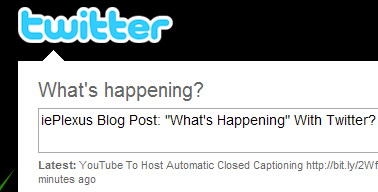 Twitter users around the world have a few questions to ask themselves. “What’s happening?” In what might seem like a minor change to some, Twitter users are now implored to answer that question rather than “What are you doing?”
Twitter’s company blog had the following to say this morning: “Twitter was originally conceived as a mobile status update service—an easy way to keep in touch with people in your life by sending and receiving short, frequent answers to one question, ‘What are you doing?’ However, when we implemented the service, we chose to leave something out. To stay simple, Twitter did not require individuals to confirm relationships. Instead, we left things open. (more…)
 A few months ago, I opened a message from someone who watched a video of mine. The message said:
“I am intrigued from reading what the people have commented on your videos. Not to mention your charismatic expression…
One teeny-weeny problem here: I am deaf and cannot understand what you have been saying on the videos. I wonder if it is possible to subtitle your videos. The subtitles also benefit the hearing people who are learning English as foreign language.
I know the technology to add the subtitles exists, but it is not always this easy sometimes.”
This really got me thinking. I had never really thought about how the hearing impaired really can’t watch online videos and get the full effect, unless someone manually put captions on the video itself, or if the video featured signing. It’s been something on my mind and something I personally have been trying to work on. I want everyone to be able get the message — not just in my video, but in everyone else’s as well. (more…)
 When you think of watching a video online, you most likely think of YouTube. And why wouldn’t you, considering the multitude of videos to be found on that site.
In fact, there are so many videos on YouTube, some say that it would take over 600 years watch all the videos on the site today– and that’s without a bathroom break. Hulu also might come to mind. Launched in 2008, Hulu offers viewers over 10,000 hours of content from several American television networks, including NBC, ABC, and FOX along with several cable networks.
But what about Facebook? Facebook for video!? According to some recent results from Nielsen, Facebook has rapidly climbed the charts by assuming the No. 3 spot for an online video website. The popular social-networking site had streamed a total of 217.7 million views in the month of October. That’s nearly double the total from September, when Facebook had just reached the top 10 mark with 110 million views. (more…)
 Last month, Amazon released its wildly popular e-book reader, the Kindle, to an international audience. But while the online retail giant looks to shore up its market abroad, a stiff challenge could be shaping up at home. That competition is coming from an unexpected source: the smart phones many of us already own.
Many Americans are finding that their phones boast many of the same capabilities of a Kindle and other gadgets of its ilk, but in a smaller, more convenient package. According to a report by New York Times technology reporters Motoko Rich and Brad Stone, e-book apps could spell doom for specialized reading devices. (more…)
 Blogging on your company website could help you bring in more traffic. At least that’s what HubSpot is saying after a recent survey. The company sampled 1,531 HubSpot customers, most of which were small- to mid-sized businesses. Roughly 52 percent, or 795 businesses, had blogs on their sites, while the remaining 736 did not.
The study shows that companies with blogs received 55 percent more traffic than with those without. If you are wondering why it is so important to have more visitors to your site, HubSpot says it’s “because more visitors mean more people to convert to leads and sales.” (more…)
 A recent report from Weber Shandwick, a New York-based public relations firm, shows that many of the Fortune 100 companies are still trying to figure out the Twitter phenomenon taking over the planet. However, they are going to need to get onboard soon if they want to keep up with the world. The social-networking site has been very useful for companies by giving customers another way to stay in contact with their business.
Surprisingly, 27 of the 100 companies had never even touched Twitter, while the other 73 companies had created a total of 540 Twitter accounts for various departments within their company. While that seems like a lot of accounts, the report found that only 32% showed personality on their profile along with well-designed backgrounds in addition to names and/or photos of those who posted tweets.
Four percent of the accounts were no longer used and was due to either the account being “set up specifically for an event that had since ended or the account was simply abandoned. “Eleven percent of the accounts were quiet, and were categorized as placeholders to prevent what is known as “brand-jacking.” The term comes from companies creating an account so that no one else will take the account. This can cause confusion and potentially damage company reputations. This shows that companies realize the important of Twitter, but aren’t necessarily using it. The remaining 53 percent would post, but with no personality, and only posting company news or product information. (more…)
 With the power of the Internet, we are able to connect with just about anyone.
Back in middle school and high school, I had an online pen pal who lived in Munich, Germany. I personally know about two words of German, while my pen pal was trying to learn English. While we were worlds apart, we had a lot in common and always had lots to talk about. However, there was that language problem. What we ended up doing was writing our e-mails into a translator, trying to be polite to one another. Of course we all know that the translations don’t translate word for word and sometimes make for an interesting read.
Google Translator, however, has rolled out three new features which should make translations much easier. Fifty-one languages are supported by Google Translator and according to Google that’s 98 percent of the Internet community. (more…)
 Last month, we told you about Yahoo shutting down Geocities. Google has not wasted any time taking advantage of their free Web hosting site. With Google Sites, you are able to create a simple web page for your company, classroom, or even just your family. They also allow you to embed any pictures, videos or other documents you want.
Google had been getting a bit of criticism for the lack of features. So, Google has taken the constructive criticism and turned it into something “A Whole Lot Prettier” according to Mashable’s Stan Schroeder. (more…)
 YouTube has some great video. You can find video from just about anywhere, from any event, with almost anyone. And since anyone can shoot a video and post it, news organizations often showcase YouTube videos from events that they personally don’t have footage from. Of course this played a crucial role earlier this year during the national election in Iran, when journalists were banned from reporting there. Instead, the citizens of Iran took out their cameras and shot video and posted it to various sites all over the web.
However, actually finding a specific video among millions of others can be a bit tricky sometimes. A new tool designed by YouTube aims to change that. YouTube Direct will help connect websites connect with its users, most specifically news organizations with citizen journalists. (more…)